Border Collie
History
The Border Collie is descended from droving dog breeds. The name for the breed came from its probable place of origin along the Scottish English borders.Mention of the "Collie" or "Colley" type first appeared toward the end of the 19th century. Many of the best Border Collies today can be traced back to a dog known as Old Hemp.
In 1915, James Reid, Secretary of the International Sheep Dog Society in the United Kingdom first used the term "Border Collie" to distinguish those dogs registered by the ISDS from the Kennel Club's "Collie", which originally came from the same working stock but had developed a different, standardized appearance following its introduction to the show ring in 1860.
Old Hemp, a tri-colour dog, was born in September 1893 and died in May 1901.He was bred by Adam Telfer from Roy, a black and tan dog, and Meg, a black-coated, strong-eyed dog. Hemp was a quiet, powerful dog that sheep responded to easily. Many shepherds used him for stud and Hemp's working style became the Border Collie style. All pure Border Collies alive today can trace an ancestral line back to Old Hemp.
Wiston Cap (b. 28 Sep. 1963) is the dog that the International Sheep Dog Society (ISDS) badge portrays in the characteristic Border Collie herding pose. He was a popular stud dog in the history of the breed, and his bloodline can be seen in most bloodlines of the modern day Collie.Bred by W. S. Hetherington and trained and handled by John Richardson, Cap was a biddable and good-natured dog. His bloodlines all trace back to the early registered dogs of the stud book, and to J. M. Wilson's Cap, whose name occurs sixteen times within seven generations in his pedigree. Wiston Cap sired three Supreme Champions and is grand-sire of three others, one of whom was E. W. Edwards' Bill, who won the championship twice.
Introduction to New Zealand and Australia
In the late 1890s James Lilico (1861?–1945) of Christchurch, New Zealand, imported a number of working dogs from the United Kingdom. These included Hindhope Jed, a black, tan and white bitch born in Hindhope, Scotland in 1895, as well as Maudie, Moss of Ancrum, Ness and Old Bob.
It is unclear whether Hindhope Jed was a descendant of Old Hemp. Born two years after him, she is mentioned in a "British Hunts and Huntsmen" article concerning a Mr John Elliot of Jedburgh: Mr Elliot himself is well known for his breed of Collies. His father supplied Noble to the late Queen Victoria and it was from our subject that the McLeod got Hindhope Jed, now the champion of New Zealand and Australia.At the time of her departure to New Zealand, Hindhope Jed was already in pup to Captain, another of the then new "Border" strain. Hindhope Jed had won three trials in her native Scotland, and was considered to be the "best bitch to cross the equator".
In 1901 the King and Mcleod stud, created by Charles Beechworth King (b. 1855, Murrumbidgee, NSW), his brother and Alec McLeod at Canonbar, near Nyngan (north-west of Sydney), brought Hindhope Jed to Australia, where she enjoyed considerable success at sheep dog trials.
In general, Border Collies are medium-sized dogs without extreme physical characteristics and with a moderate amount of coat, which means not much hair will be shed. Their double coats vary from slick to lush, and come in many colours, although black and white is the most common. Black tricolour (black/tan/white or sable and white), red (chocolate) and white, and red tricolour (red/tan/white) also occur regularly, with other colours such as blue, lilac, red merle, blue merle, brindle and "Australian red"/gold seen less frequently. Border Collies may also have single-colour coats.
Eye colour varies from deep brown to amber or blue, and occasionally eyes of differing colour occur. (This is usually seen with "merles"). The ears of the Border Collie are also variable — some have fully erect ears, some fully dropped ears, and others semi-erect ears (similar to those of the rough Collie or sighthounds). Although working Border Collie handlers sometimes have superstitions about the appearance of their dogs (handlers may avoid mostly white dogs due to the unfounded idea that sheep will not respect a white or almost all white dog), in general a dog's appearance is considered to be irrelevant . It is considered much more useful to identify a working Border Collie by its attitude and ability than by its looks.
Dogs bred for showing are more homogeneous in appearance than working Border Collies, since to win in conformation showing they must conform closely to breed club standards that are specific on many points of the structure, coat and colour. Kennel clubs specify, for example, that the Border Collie must have a "keen and intelligent" expression, and that the preferred eye colour is dark brown. In deference to the dog's working origin, scars and broken teeth received in the line of duty are not to be counted against a Border Collie in the show ring.
Height at withers: Males from 19 to 22 in (48 to 56 cm), females from 18 to 21 in (46 to 53 cm).

Border Collies require considerable daily physical exercise and mental stimulation.
Border Collies are an intelligent breed. The breed has an instinctive desire to work closely and intensely with a human handler. Although the primary role of the Border Collie is that of the working stock dog, dogs of this breed are becoming increasingly popular as pets.
True to their working heritage, Border Collies make very demanding, energetic pets that are better off in households that can provide them with plenty of play and exercise with humans or other dogs.
As long as the Border Collie is in the herding/working position (crouched down, tail tucked between legs, eyes firmly fixed on the matter in hand) it considers it work. Their tails are about as long as their body.
A Border Collie's tail, based on position, shows the mindset the dog is in. A raised, wagging tail is called a "gay tail" by shepherds because it usually indicates the dog is excited and not concentrated on work. The tail lowered or tucked between the legs indicates the dog is focused and ready to listen/work.
Border Collies are now also being used in showing, especially agility, where their speed and agility comes to good use.
Though they are common choice for household pets, Border Collies have attributes that makes them less suited for certain people who have small children and cannot give them the exercise they need. As with many working breeds, Border Collies can be motion-sensitive and they may chase vehicles occasionally or a small child in the garden running around as these are both very similar to herding sheep.
Rhodesian Ridgeback
The Rhodesian Ridgeback is a dog breed developed in Southem Africa where it was used (amongst other things) to hunt lions. This is most likely why this dog is known for its bravery.
In the earlier parts of its history, the Rhodesian Ridgeback has also been known as the African Lion Hound or African Lion Dog—Simba Inja in Ndebele, Shumba Imbwa in Shona—because of their ability to distract a lion while awaiting their master to make the kill.
The original breed standard was drafted by F.R. Barnes, in Bulawayo, Rhodesia (today known as Zimbabwe), in 1922. Based on that of the Dalmatian, the standard was approved by the South African Kennel Union in 1926.This dog is now used to help athletes train.
The Rhodesian Ridgeback's distinguishing feature is the ridge of hair along its back, running in the opposite direction to the rest of its coat. It consists of a fan-like area formed by two whorls of hair (called "crowns") and tapers from immediately behind the shoulders down to the level of the hips. The ridge is usually about 2 inches (5 cm) in width at its widest point. It is believed to originate from the dog used by the original African dog population, which had a similar ridge. The first depiction of a Ridgeback is a wall painting describing the life of the Boers, housed in South Africa in the Voortrekker Monument.

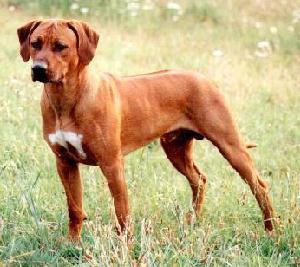
The Rhodesian Ridgeback is a large, muscular hound. The broad head is flat between the ears. The muzzle is long and deep, with a defined stop. The nose is either black, brown or liver, depending on the coat of the dog. The eyes are round and are usually brown depending on the shade of the dog. The medium sized ears are set high, dropping down, wide at the base and tapering to a point. The chest is deep. The front legs should be very straight and strong. The tail is fairly long, thicker at the base, tapering to a point curving upward slightly. Dewclaws are sometimes removed. The coat is short and dense with a clearly defined symmetrical ridge of hairs growing in the opposite direction down the middle of the back. Coat colors include light wheaten to shades of red sometimes with a little white on the chest and toes.
Temperament
A fine hunter, the Rhodesian Ridgeback is ferocious in the hunt, but in the home it is a calm, gentle, obedient, good dog. Good-natured, but some do not do well with small children because they may play too roughly and knock them down. They are intelligent, skillful and straight-forward dogs that are loyal to the family. They are brave and vigilant. Can be reserved toward strangers, socialize well. They possess considerable stamina and without enough mental and physical exercise they can become high strung and unmanageable. This breed needs a firm, confident, consistent pack leader who can provide rules the dog must follow and limits to what it can and cannot do. Meek and/or passive owners, or owners who treat the dog like a human rather than a canine will have a hard time controlling this breed and may also cause them to become combative with other dogs. When given what they need as the canine animal they will be excellent companion dogs, but are not recommended for most people, as most do not have the time nor energy to put into them. Ridgeback's react best to an extremely consistent and firm but calm approach to training. They are intelligent and learn quickly, but will be stubborn and willful if they are stronger-minded than the humans. Training should be gentle, but firm and should start young while the dog is still small enough to manage. They are also very good watch dogs, but not suggested for guard dogs. They are very protective of owners. This has to be addressed during their early training. This breed can be more destructive than a Lab if not given enough exercise and is not convinced the humans are his authority figure. Do not overfeed this breed. Provided this dog meets cats and other pets when it is young, any potential problem will be prevented. Ridgebacks make excellent jogging companions.
Height, Weight
Height: Dogs 25-27 inches (63-69cm) Bitches 24-26 inches (61-66cm)
Weight: Dogs 80-90 pounds (36-41kg) Bitches 65-75 pounds (29-34kg)
Health Problems
Rhodesian Ridgebacks are a hardy breed, able to withstand dramatic changes of temperature, however they are susceptible to hip dysplasia, dermoid sinus, and cysts.
Living Conditions
Rhodesian Ridgebacks will dog okay in an apartment as long as they get enough exercise. They are relatively inactive indoors and do best with a large yard.
Exercise
These dogs have great stamina and you will tire long before they do. They need to be taken on daily, long, brisk walks or jogs. In addition, it needs plenty of opportunity to run, preferably off the leash in a safe area. If these dogs are allowed to get bored, and are not walked or jogged daily, they can become destructive and start to display a wide array of behavioral problems.
Life Expectancy
About 10-12 years.
Čestitamo!
Ukoliko možete da pročitate ovaj članak, uspešno ste se registrovali na Blog.rs i možete početi sa blogovanjem.